


Piotr Kowalewski Jahromi
dr, Instytut Historii Uniwersytetu Śląskiego w Katowicach
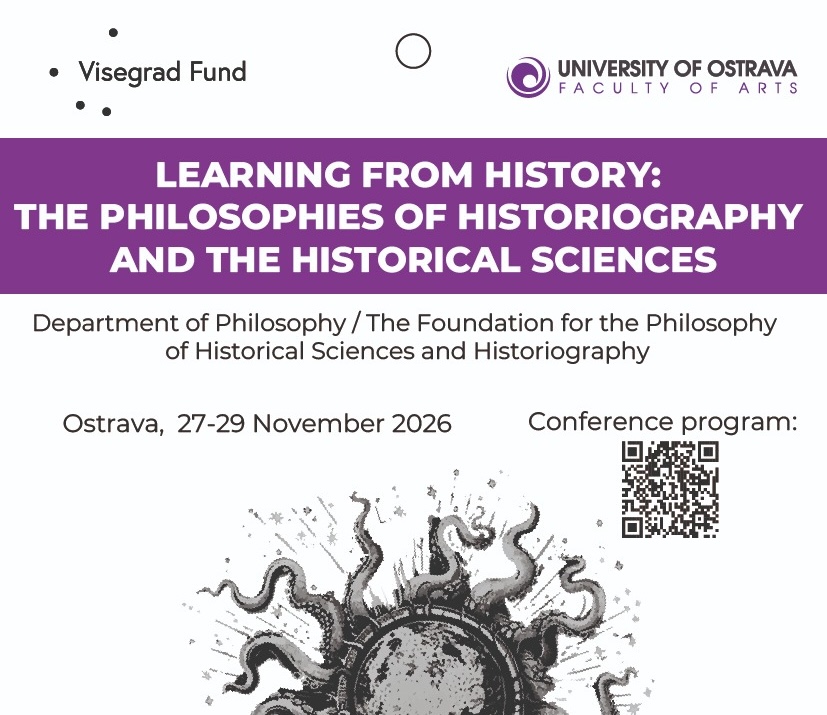
Zapraszamy do rejestracji i śledzenia strony międzynarodowej konferencji naukowej zorganizowanej przez Uniwersytet w Ostrawie 27-29 listopada 2026.
Konferencja jest zorganizowana w ramach Grantu Wyszehradzkiego kierowanego przez Uniwersytet Katolicki w Rużomberku (Słowacja) we współpracy z Uniwersytetem w Ostrawie (Czechy) oraz Uniwersytetem Śląskim w Katowicach (Polska). W ramach grantu planowane jest seminarium w Katowicach oraz szkoła letnia w Rużomberku w 2027 roku.
Poniżej informacje dotyczące konferencji w Ostrawie:
Learning from History: International Conference Brings Leading Philosophers of Historical Science to Ostrava
How can we learn from the past, and what can the historical sciences teach us about the nature of knowledge? An international conference at the University of Ostrava will bring together some of the world’s leading philosophers, historians, and historical scientists to address these pressing questions.
How do we learn from the past? What kinds of evidence allow us to reconstruct events that are no longer directly observable? And what can the rapidly developing historical sciences teach us about the nature of historical knowledge? These questions will be at the center of the international conference Learning from History: The Philosophies of Historiography and the Historical Sciences (link to: https://ff.osu.eu/phil-hist/conference-learning-from-history/), which will take place at the University of Ostrava on 27-29 November 2026. The conference is organized by the Foundation for the Philosophy of Historical Sciences and Historiography (link to: https://ff.osu.eu/phil-hist/) and is part of the Visegrad-funded project What Can Be Learned from History: Philosophical Reflections from Central Europe (link to: https://history.ku.sk). The project is led by the Catholic University in Ružomberok, in partnership with the University of Ostrava and the University of Silesia in Katowice, bringing together leading Central European institutions committed to advancing research in the philosophy of history and the historical sciences.
The conference responds to one of the most dynamic developments in contemporary philosophy and historiography: the growing importance of the historical sciences. New forms of evidence, sophisticated methods of interpretation, and interdisciplinary cooperation are expanding our ability to understand the past. These developments raise important philosophical questions concerning the nature of historical evidence, the reliability of inferences about past events, and the foundations of historical knowledge. The conference aims to contribute to the development of a new area of research within philosophy of science focused specifically on historiography and the historical sciences.
The event will bring together an exceptional group of internationally recognized scholars. Confirmed keynote speakers include Carol Cleland, Adrian Currie, Michal Hubálek, Jouni-Matti Kuukkanen, James McAllister, Gregory Radick, Franziska Reinhard, Adam Timmins, Aviezer Tucker, Peter Turchin, and Derek Turner.
Among the keynote speakers, Carol Cleland is widely regarded as one of the founders of the contemporary philosophy of historical science. Her influential work has demonstrated how scientists can acquire reliable knowledge of past events through traces and remnants rather than controlled experimentation. Her ideas have profoundly shaped philosophical debates concerning paleontology, geology, archaeology, astrobiology, and other historical sciences.
Peter Turchin is a pioneer of cliodynamics, an interdisciplinary approach that combines historical research with mathematical modelling and large-scale data analysis. His work has stimulated international debate about whether long-term historical processes can be systematically explained and whether recurring patterns in social development can be identified through quantitative methods.
Derek Turner is widely known for his contributions to the philosophy of paleontology and historical explanation. His research examines how scientists reconstruct deep history from incomplete and imperfect evidence, offering important insights into uncertainty, underdetermination, and historical inference.
Aviezer Tucker, founder of the Foundation for the Philosophy of Historical Sciences and Historiography, has played a leading role in developing the philosophical study of historical knowledge. His work addresses evidence, expertise, explanation, and the methods through which historians and other historical scientists justify knowledge claims about the past.
Adrian Currie is one of the most innovative philosophers of historical science today. His research explores how scientists and historians investigate the past using fragmentary evidence, interdisciplinary methods, and imaginative reasoning. Through influential works such as Rock, Bone, and Ruin, he has shown how paleontologists, archaeologists, and historians generate robust knowledge despite working with incomplete data, helping to redefine philosophical understandings of evidence and scientific inquiry.
Jouni-Matti Kuukkanen is among the most influential contemporary philosophers of historiography. His writings on historical interpretation, narrative representation, and historical argumentation have significantly advanced our understanding of how historians construct, justify, and communicate historical knowledge.
The conference will also feature several other distinguished scholars. Gregory Radick is internationally recognized for his work on the history and philosophy of biology, particularly Darwinism and evolutionary thought. James McAllister has made important contributions to the philosophy of science through his research on scientific explanation, aesthetics, and theory change. Michal Hubálek, Franziska Reinhard, and Adam Timmins represent a new generation of scholars advancing innovative research in the philosophy of historiography and the historical sciences.
By bringing together philosophers, historians, and scholars of the historical sciences from across Europe and beyond, the conference will provide a unique forum for exploring how knowledge of the past is produced and how historical understanding can inform present-day decision-making. It also highlights the growing contribution of Central European institutions to international debates on historiography, the philosophy of history, and the philosophy of historical science.
The conference is part of the project co-financed by the governments of Czechia, Hungary, Poland and Slovakia through Visegrad Grants from the International Visegrad Fund (link to: https://www.visegradfund.org). The mission of the fund is to advance ideas for sustainable regional cooperation in Central Europe.
Plik do pobrania - Ostrava-conference-poster-2026.pdf